Thursday, 16 May 2013

Another new Plateosaurus

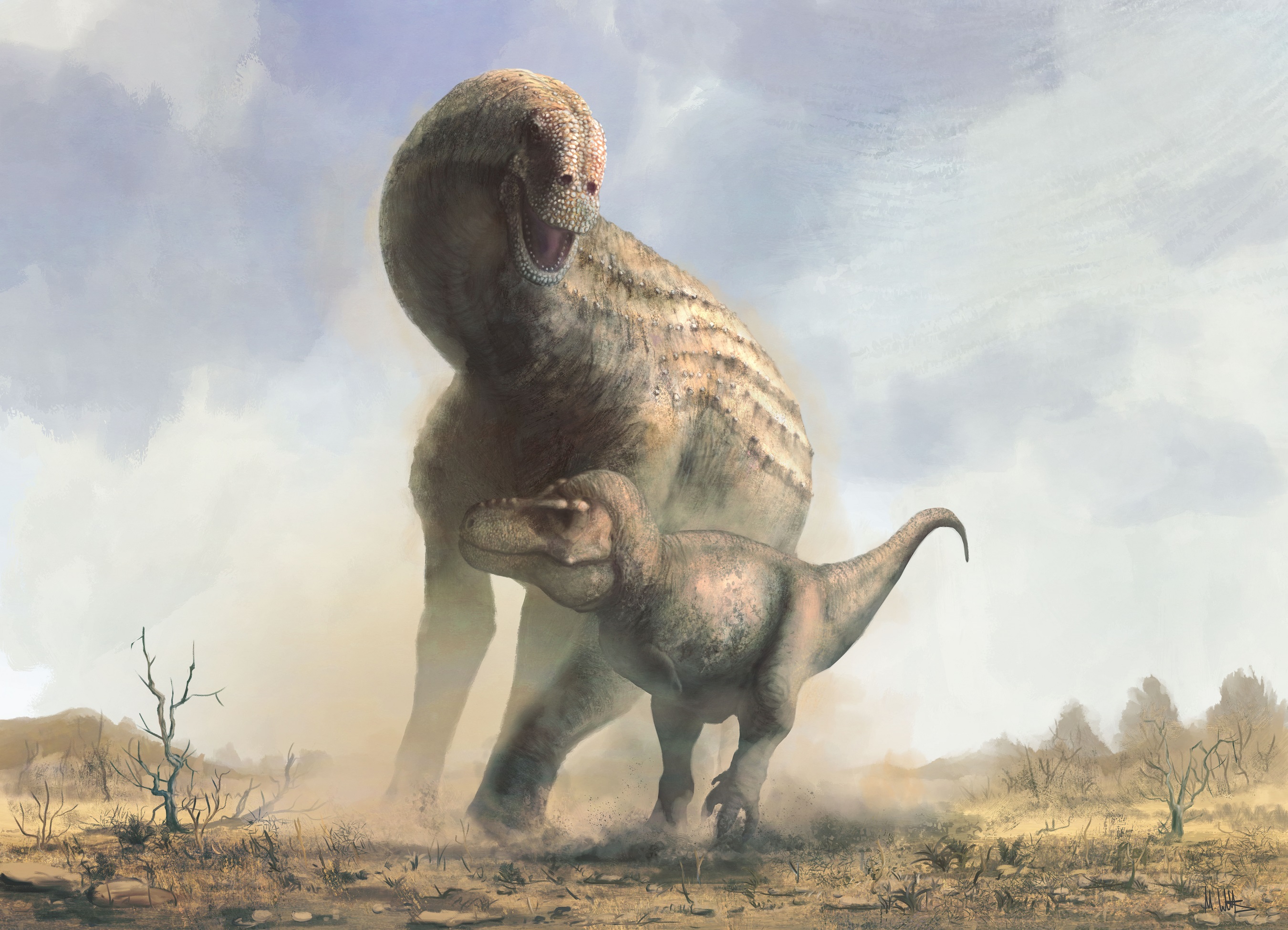
A modern reconstruction of Plateosaurus engelhardti as a relatively bird-like, bipedal animal rather than a tubby, sprawling  quadruped
It turns out that you can teach an old dinosaur some new tricks. Remains of Plateosaurus engelhardti have been known since at least 1837 but, thanks to a flurry of recent research into its anatomy, posture and gait, we've learnt many surprising facts about this animal in the last few years. The restoration offered here is an attempt to portray this animal in its most recent, modern light and, in many details, it contrasts markedly with reconstructions even only a few years ago.

'New looks' for Plateosaurus are not rare, however. Our perceptions of this dinosaur have been rather changeable since its discovery, and few dinosaurs have been through as many iterations of posture, gait and general appearance. Since its discovery in the early 1800s, we've seen Plateosaurus reconstructed in numerous ways. Perhaps the oldest known reconstruction, by O. Jaekel, dates to 1913-1914 and depicts a very different animal to the one we know today. This frequently proportionally inaccurate image shows a very odd-looking bipedal dinosaur which almost has a therizinosaur-like appearance, but perhaps is better compared to Igor from an early Universal horror film. Later depictions of Plateosaurus were of a sprawling quadruped with a barrel-like chest; an erect biped with a dragging tail; a lithe quadruped capable of galloping; a very sauropod-like animal with straight, columnar limbs and a long, low biped with a heavy balancing tail. These interpretations, and others, have been compiled and thoroughly discussed by Heinrich Mallinson, a man who clearly loves Plateosaurus as much as a man can love a fossil species (below, from Mallinson 2010a).

The many faces of Plateosaurus, compiled by Mallison (2010a). Check out Heinrich's open-access publication for sources of the reconstructions.
This wealth of conflicting interpretations is odd when we consider that, among non-sauropodan sauropodomorphs and perhaps dinosaurs generally, the osteology Plateosaurus is very well known. Numerous articulated skeletons, some essentially preserved standing in miring muds, inform us about details of limb carriage and girdle configuration (see image, below), but it seems that much of this data was overlooked by scientists and artists restoring Plateosaurus for decades. Once the fine anatomy and taphonomic data of these animals was assessed in detail however, it became very apparent that most of our interpretations of Plateosaurus were simply plain wrong. The palms of the Plateosaurus hand were forever facing medially, like those of theropod dinosaurs and unlike many of the reconstructions shown above (Bonnan and Senter 2007). It's forelimbs had an extremely limited range of motion, which more-or-less only permitted movement beneath the body (Mallison 2010a). When the entire skeleton was reconstructed without disarticulated bones, the narrowness of the chest and shoulders became apparent, contrasting with the enormous bellies of many mounted skeletons and sculptures. The rigidity of its avian-like torso skeleton and disproportionate limbs were also brought to light (Mallison 2010a, b, and references therein).

SMNS F33, one of the most famous articulated fossils of Plateosaurus engelhardti. Note the narrowness of the chest and shoulders. Photograph by FunkMonk, from Wikipedia Commons.
In essence, it seemed that virtually all reconstructions of Plateosaurus prior to 2010 were committing some sort of major anatomical sin, requiring disarticulation of bones or over-flexed joints in order to achieve their portrayals. Perhaps most obviously, it seems that quadrupedal locomotion, be it a slight sprawl or a horse-like gallop, was not possible for Plateosaurus (and perhaps most other non-sauropodan sauropodomorphs). Rather, the reach, attitude and length of their forelimbs indicate that they were habitual bipeds, and their centre of gravity dictated that they held their backs subhorizontally. Gone too were the round, barrel-like chests: despite being a  6-10 m long herbivore, Plateosaurus was a surprisingly gracile animal that was perhaps even capable of moving relatively quickly on its powerful back legs. The contrast of this new appearance with some of the older, sprawling reconstructions of this animal is rather pronounced.

(Interesting bonus knowledge to stem from recent Plateosaurus studies include new insights into the suppleness of the Plateosaurus neck, which permitted 360° to their owners. Presumably, this reflects a need to keep an eye out for predatory archosaurs which, in the Late Triassic landscapes occupied by Plateosaurus, would not be predatory theropods but large rausuchians like Teratosaurus. [How come there's not many illustrations of predatory interactions between these species? Would probably make for a cool image]. Perhaps even more interestingly, the pedal claws of Plateosaurus show evidence of being used in scratch digging, which may reveal how these animals dug their nests. Neat stuff indeed.)

Junk about the trunk
But it's not just Plateosaurus specific topics that have fuelled the latest changes in its appearance. It's very likely that the tail of Plateosaurus was more massive and heavy than portrayed in most reconstructions because, along with many other dinosaur species, it bore substantial hindlimb musculature along the base of its tail. We can see how large the hindlimb retractor muscles of dinosaurs should have been by looking at homologous anatomies in lizard and crocodile tails (warning: that link is not for the squeamish), and the take-home message is that most dinosaurs had extremely beefy proximal tail regions (e.g. Persons and Currie 2011). As Heinrich covers here, we can see osteological evidence for expansive, tail-anchored hindlimb muscles in Plateosaurus as clearly as we can in nearly all other Mesozoic dinosaur species. The Plateosaurus anterior tail regions was effectively a big tube of meat bulging from a thread of vertebrae, which were themselves enlarged for the attachment of powerful muscles. In life, the hindlimb protractors would probably run continuously from the tail to the hindlimb, with no obvious 'join' between these two body sections. These bulging tails are a world away from the slender and compressed tails seen in many pieces of palaeoart. Furthermore, all this proximal tail muscle probably reduced the flexibility of the tail somewhat (Persons and Currie 2011) suggesting that another palaoart trope - dinosaurs with laterally wavy, sinuous tails - were probably impossible. The extensive muscles at the base of the tail can only be compressed so far by a wiggling tail. Thus, although the tail bones of Plateosaurus seem to offer a fair amount of lateral motion (below; also see Mallison 2010a), there probably wasn't anything close to that level of flexibility available in life. In the picture above, the tail is deliberately a little lifeless, acting purely as a site for hindlimb retractor muscle anchorage and a counterbalance to the heavy, gut-filled torso.
Digital model of Plateosaurus caudal vertebrae in dorsal view, showing 10° flexion between each joint. From Mallison (2010a).
Feathers? Really...?
So, new posture, new build, new tail, and now new integument? We're very used to seeing Plateosaurus and with virtually all other sauropodomorphs with scales, but this may not have been the case  (hat tip here to recent blog posts on this topic by the Internet's favourite sauropod workers, Matt Wedel and Mike Taylor). Sauropodomorphs may not have provided any fuzzy revelatory fossils over the last few years but, because lots of other dinosaur groups have, the landscape of dinosaurian integument has shifted considerably around their feet. Nowadays, it's a commonly known possibility that dinosaurs, and perhaps all ornithodirans, were ancestrally fuzzy. Although we have a few skin impressions from sauropods (Czerkas 1992; Coria and Czerkas 2007), they remain pretty rare across the group as a whole and, to my knowledge, we don't have any from non-sauropodan sauropodomorphs. Our few scraps of sauropod skin suggest they bore typically archosaurian, non-overlapping scales but, even if that's standard for the group (and, given what we know about modern animal integument, it may well not be), it isn't clear when this trait became a typical part of the sauropod bauplan. Thus, it is not inconceivable that some early sauropodomorphs were feathered and, until we have some direct evidence either way, it's probably just as parsimonious (and, arguably, speculative) to draw them with fuzzy hides as it is with scales. In the case of the picture here, I figured throwing an ostrich-like distribution of feathers over a modern Plateosaurus reconstruction added a suitably symbolic purpose to show how far interpretations of this animal have come since its first discovery.

And that may be enough novelties for one day: time to crack on with other things. Here's hoping that this reconstruction of Plateosaurus will stand the test of time, though I'm sure I'm merely tempting fate with those words. Next week, hopefully, we'll see something to do with animals bearing membranes, because this thing isn't very far from being released on the world any more.

References

  • Bonnan, M. F., and P. Senter. 2007. Were the basal sauropodomorph dinosaurs Plateosaurus and Massospondylus habitual quadrupeds? In: Barrett, P.M. and Batten, D.J. (eds.), Evolution and palaeobiology of early sauropodomorph dinosaurs. Special Papers in Palaeontology, 77, 139-155.
  • Coria, R. A. and Chiappe, L. M. 2007. Embryonic skin from Late Cretaceous sauropods (Dinosauria) of Auca Mahuevo, Patagonia, Argentina.  Journal of Paleontology, 81, 1528-1532.
  • Czerkas, S.  A. 1992. Discovery of dermal spines reveals a new look for sauropod dinosaurs. Geology 20, 1068-1070.
  • Mallison, H. 2010a. The digital Plateosaurus II: an assessment of the range of motion of the limbs and vertebral column and of previous reconstructions using a digital skeletal mount. Acta Palaeontologica Polonica, 55,433-458.
  • Mallison, H. 2010b. The digital Plateosaurus I: body mass, mass distribution and posture assessed using CAD and CAE on a digitally mounted complete skeleton. Palaeontologia Electronica 13.2.8A
  • Persons IV, W. Scott, and Philip J. Currie. 2011. The tail of Tyrannosaurus: reassessing the size and locomotive importance of the M. caudofemoralis in non‐avian theropods. The Anatomical Record: Advances in Integrative Anatomy and Evolutionary Biology, 294.1, 119-131.

Wednesday, 8 May 2013

Ray Harryhausen, 1920-2013

A prehistoric animal being lassoed by cowboys alongside ruined temples in a barren landscape? Sounds like a Harryhausen movie. Oh wait: it kinda was.
There aren't many people in the public eye who I admire, but the pioneering stop-motion artist Ray Harryhausen was one of them. Harryhausen didn't kick start my interest in palaeontology in the first place, but his animated dinosaur sequences were certainly one of the highlights of my dinosaur obsessed childhood. I still watch his films today, both dinosaur-themed and otherwise. In fact, I watched two of them just this weekend. Turns out this was strangely timely: as we all know by now, it was announced that Harryhausen passed away yesterday (7/5/2013) at the age of 92.

I'm not alone among palaeontologists in revering Harryhausen's work. Few other special effects artists in the 20th century could make dinosaurs and other prehistoric animals come alive quite like Harryhausen, and it was perhaps only the sophisticated animatronics and CG effects in 1993's Jurassic Park which clearly superseded his work. Indeed, to appreciate Harryhausen's work fully you had to live in pre-JP times, where movie dinosaurs were generally pretty poorly executed. Before Jurassic Park, most movies dinosaurs were modern lizards and crocs dressed up with horns and sails, shonky animatronics and puppets, or else men in oversize reptile costumes. None of these approaches were terribly convincing. Harryhausen's stop motion models, by contrast, looked and acted like the real thing, battling with people and other creatures as if they were present on set. With very few exceptions, there was simply nothing closer to seeing actual dinosaurs than Harryhausen's animations until 1993. It's hard to chose a favourite scene from his dinosaur works, but in terms of overall execution, I think his Allosaurus attack in the 1966 film One Million Years BC may be among his best (below, borrowed from Apollomovieguy). As with all Harryhausen's creations, the animal in this scene is full of character thanks to subtle movements of its head and body. At times the allosaur comes across as a genuine actor in the production, and one who thinks that the movie is below him. Some of his lazier snaps and turns suggest it's just walking the part rather than playing the ferocious animal it could be. You can almost see it thinking 'well, at least I'll be able to pay the rent this month' as it snaps, idly, at the cavefolk. It's only when it's allowed to run across the set and savage people that it really seems to surrender to the role. I don't mean these a criticisms: Harryhausen's careful animation that gives the animal these little flourishes of character that make his films a joy to watch. There are numerous other examples we could cite of this sort of thing: Talos staggering a little when climbing from his plinth, and is preferentially uses his right hand, in Clash of the Titans (1981); Gwangi tugging at the lasso ropes around his neck with his little arms in Valley of Gwangi (1969) and so forth.


Although we may automatically think of dinosaurs when Harryhausen is mentioned, he actually only made three movies which contain 'proper' Mesozoic dinosaurs: The Best from 20,000 Fathoms (1953), One Million Years BC (1966) and Valley of Gwangi. Indeed, we're only including Beast on a technicality. The plot suggests that the 'Rhedosaurus' creature is a dinosaur, but it looks more like a giant lizard than a theropod. I get the impression that Harryhausen would have liked to have worked with dinosaurs more,  apparently trying to drum up interest for further other dinosaur movies or crowbar them into other productions (Sinbad was meant to meet a ceratopsian in a fourth film in that series). He certainly seems to frequently mention dinosaurs in a favourable light in interviews, and some of his first stop-motion models - made when he was a young teenager, were of famous dinosaur species. He did, of course, animate a short sequence of dinosaurs for the 1956 documentary Animal World, which was his only attempt to show dinosaurs in a natural time and setting*. A few other Harryhausen movies - Mysterious Island (1961) and Clash of the Titans - featured avian dinosaurs, but, in all, he actually made relatively few productions featuring the 'classic' dinosaurs. Much of his filmography is comprised of other fantasy or science fiction fare, so his dinosaur movies are, in fact, a minority of his work. Clearly, his dinosaur scenes were well executed enough to remain prominent in our memories even if, when put together, they only comprise a few minutes of footage.

*Unlike his other dinosaur scenes, the models for Animal World were made from injection foam, a cheaper but inferior material to his preferred medium of layered latex, and the sequence features closeups of awkward looking robotic miniatures. For this and other reasons, Harryhausen was never really happy with his work on Animal World and, although the stop-motion still stands up, it's easy to see why he did not consider it as highly as his other projects.

I find it interesting that palaeontologists are so fond of Harryhausen's work considering his sometimes flippant regard for scientific accuracy. Palaeontologists can be real sticklers for such issues, and Harryhausen had a pretty loose concept of what dinosaurs were like (which may explain his 'dinosaur' in The Beast from 20,000 Fathoms). He frequently over-scaled his animals to make them more formidable, or hybridised different species for dramatic effect. The theropod Gwangi is well known as being a hybrid of Tyrannosaurus and Allosaurus, and he added bat-like wings and owl talons to pterosaurs (see his Pteranodon model, below, borrowed from my Pterosaur.Net post on this very topic). Harryhausen played loose with myths as well. His harpies, featured in the 1963 film Jason and the Argonauts, have bat-like wings instead of the feathered wings described in folklore, and his Medusa, from Clash of the Titans, sports a rattlesnake abdomen not mentioned in any literature on this creature.


Despite his loose interpretation of source material, Harryhausen rarely invented completely novel anatomies for his creatures, even when working with entirely novel concepts. His anatomies always had a source in the real world, and it was his combination of animal components which resulted in different models. It's for this reason that Harryhausen's creations share the same appearance, as some of his anatomical 'building blocks' have a signature style. The Kraken from Clash of the Titan, for instance, has the body resembling his JatA Talos model (down to the navel and nipples, which are curious features on a titan), the head is rather like Ymir from 20 Million Miles to Earth (1957) and the arms are clearly borrowed from the octopus in It Came from Beneath the Sea (1955). These characters all represent very different types of beast - mythological titans, aliens, and giant animals - but they all share Harryhausen's artistic DNA.

For all of his recycling of designs and body parts though, Harryhausen never tweaked his creations so far from their source material that they were unrecognisable. They were enhanced, sure, but never distorted. Palaeontologists watching his dinosaur flicks could feel satisfied that his animals more-or-less looked matched concepts of these animals fashionable in the 50s and 60s. Besides, his animations are too unapologetically focussed on entertainment to warrant harsh scrutiny. You can nitpick Gwangi's anatomy all you like, but you'll be missing the coolest dinosaur round up scene ever committed to film if you do. The plots of Harryhausen's films, which he was often a key producer of, are all about pulpy entertainment and nothing more. They appeal to the little boys and girls in all of us, and aren't asking for detailed critiques of their stories, scientific plausibility or even scripts and acting. Can anyone in touch with their inner child honestly say that they're not interested in watching cowboys round up a tyrannosaur, or a dinosaur destroying a lighthouse? Harryhausen's ideas are simply so charismatic that they're practically immune to scientific criticism.


Harryhausen's legacy is not just one a charismatic storyteller and skilled special effects artist, however. It's well known that Harryhausen was one of the signature stop-motion artists of the 20th century, but the fact that he saved stop-motion as an artform in the 1940s and 50s isn't common knowledge. Early stop-motion techniques pioneered in films like The Lost World (1925) and King Kong (1933) by Harryhausen's mentor, Willis O'Brian, were wonderfully executed but extremely time consuming and expensive, even by standards of stop-motion photography. O'Brian's techniques employed setting several painted landscapes on glass between his animated models and the camera, thus creating the impression that the creatures were set in middle distance. The process of painting these landscapes and compositing these shots, in addition to animating the models and other technical work, was so intensive that most studios were unwilling to invest the necessary time and money into stop motion work. Harryhausen's childhood interest in stop-motion animation, fired by multiple viewings of King Kong and some very supportive parents, allowed him to develop matting techniques which negated the need for painted glass landscapes, in which components of the filmed footage could be re-photographed on top of the animated scene. This cut the time and material costs of stop-motion processes drammatically, and he pioneered this technique, which he would eventually call 'dynamation', before he landed his first solo job on a motion picture. Dynamation was first put to the test on the low budget Beast from 20,000 Fathoms, and Harryhausen delivered his work for a fraction of the cost of traditional stop motion. Without this revolution in stop-motion, the artform as we know it may never have happened. That may not seem like a big deal to us now in a time of CG effects, but bear in mind that Jurassic Park was greenlit with a sophisticated form of stop-motion in mind.


In his career, Harryhausen more-or-less single handedly lent his dynamation craft, and other special effects wizardry, to something like 16 motion pictures (see compilation, above, by Vidar Solaas). If the testimonies of the numerous fans and film makers are accurate, the movie world would be a very different place without them. There's so much more we could say about Harryhausen: his abilities as an artist and sculptor, the vast numbers of films he designed that were never made (War of the Worlds with Harryhausen tripods!), the many, many stories he has shared about making his films, but there's simply not enough time to relate even a fraction of them here. If you want to know this sort of stuff, though, I thoroughly recommend you track down either his richly illustrated autobiography and collected artworks, or the recent critically acclaimed documentary Ray Harryhausen: Special Effects Titan.

On that note, it's time to get on with other things. Thanks then for everything, Ray, you will be missed.

Friday, 3 May 2013

The Walking with Dinosaurs 3D trailer lands


Good news, everyone: the PR machine behind Walking with Dinosaurs 3D has provided our first detailed look at the film with its first trailer. I'm rather excited about this because it's my first real look at the film since contributing character orthographics for several (six, specifically) of its animals in early 2011, a process that involved working with a fleet of palaeontological and palaeoartist supernauts: David Krentz, Scott Hartman, Tom Holtz, Scott Sampson, Luis Chiappe, Victoria Arbour and others. Since that time, the guys at Animal Logic have been crunching the ones and zeroes required to breath life into the characters and their world, with the results posted above. There's always an air of uncertainty surrounding palaeontological film projects but, happily, this first trailer suggests WwD3D is taking good shape, and the Facebook and Twitter buzz from the contributors mentioned above suggests they're pretty happy with what they've seen, as am I. Be sure to set the trailer stream to its highest, 1080p HD quality to take in all the details.

Highlights of this first teaser, aside from some excellent zbrush creations from David Krentz and the stunning visuals and animation, include feathered dromaeosaurs, an iridescent gorgosaur and suitably snowy slopes in latest Cretaceous Alaska. I like the efforts to characterise individual animals without resorting to crazy variations in colour and form, such as the hole in the frill of the hero Pachyrhinosaurus. Presumably, this reflects a pathology that never entirely healed, and it's a cool idea. So cool, in fact, that I'm wondering why it's not more common in palaeoart. We can also see that the colour schemes of the animals are striking without being outlandishly garish, and the characters seem capable of emoting without using overblown actions akin to those of other CG dinosaurs, who seem to have gone to an acting school for 1920s silent movies. Moreover - stop press - plenty of shots even show animals with not roaring and with their mouths closed. Gosh.

So, there's plenty to be happy about then, and my feeling from reading the comments of others is that I'm not alone in this view. Perhaps the only common niggle being raised is that the tyrannosaur is scaly rather than feathered, which jars with recent discoveries showing some big tyrannosauroids were covered in protofeathers (Xu et al. 2012). Obviously, it would have been extremely cool to render this in WwD3D, but the feathered tyrant Yutyrannus arrived just a little too late in the day for the design team to work feathers onto the Gorgosaurus. As hinted above, the creature designs for the WwD3D animals were being set in late 2010 and early 2011, well over a year before Yutyrannus was unleashed on the world. And we shouldn't be too upset: there is still controversial evidence that another tyrannosaur, Tyrannosauruswas scaly, and the WwD3D Gorgosaurus still looks awesome.

But enough about dinosaurs: what about the real stars of the show, the pterosaurs? It may not be surprising that I had a hand in design and consultancy for the movie's azhdarchids, and I'm happy to say that I like what I can see thus far. Flap-gliding and full-on flapping flight are both on display, and just short of the one minute mark, we see a gang of azhdarchids surround and aggressively 'terrestrially stalk' the hero animals. If you're sad enough to have freeze-framed high-definition shots of the azhdarchids (which, er... I didn't, but a friend of mine did) you'll notice thick coats of soft pycnofibres, and that the internal anatomy of azhdarchid jaws have, for the first time, been accurately rendered on film. Indeed, the contours of the head are the best I've ever seen in a CG azhdarchid. Note the concave lateral skull facia, the tapering shape of the tomial margins... wonderful stuff. I'm very much looking forward to seeing them on screen later in the year.

So, this is all shaping up very well then, making the December 20th release date something to look forward too. It almost seems that fans of Mesozoic reptiles on film are being spoilt at present, with WwD3D following 2011's terrific (and underrated) Dinosaur Revolution/Dinotasia and the excellent BBC series Planet Dinosaur. Indeed, the BBC's dinosaur coverage is on something of a roll at present. Presumably as part of the PR campaign for the new film, its revamped Walking with Dinosaurs website has been providing good coverage of recent dinosaur topics in a way that is extremely accessible but not dumbed down (for a good example of this, see their coverage of the Torosaurus/Triceratops debate). Several well-known contributors to the palaeo blogosphere have been contributing new content to the site too, so it's definitely worth checking out if you haven't already.

And that will have to do for now: lots of work to catch up with. In the meantime, I leave you, and particularly if you're a 20th Century Fox or BBC executive, with a pitch for a WwD3D spin-off, starring the animals I'm sure will steal the entire movie. It's Box Office Gold, I tell you.


Reference

  • Xu, Xing, Kebai Wang, Ke Zhang, Qingyu Ma, Lida Xing, Corwin Sullivan, Dongyu Hu, Shuqing Cheng, and Shuo Wang. 2012. A gigantic feathered dinosaur from the Lower Cretaceous of China. Nature, 484, 92-95.

Wednesday, 24 April 2013

They're reptiles Jim, but not as we know them

A couple of Therizinosaurus cheloniformis in a Cretaceous woodland,  one of whom is making the loudest 'coo coo' noise you've ever heard, and one of whom couldn't care less.
There is no 'saur like a therizinosaur. That should be a well-known saying among palaeontologists, but it's not. They're all too busy doing science to come up with silly puns, no doubt. This painting of these magnificent animals came as a response to my previous post concerning 'Feather Resistance' (the fact that some people just don't like the idea of feathered dinosaurs) which featured a photo of the feathered remains of the small Chinese therizinosaur Beipiaosaurus. The neck vertebrae of this specimen thread through an extensive, posteriorly-expanding wedge of neck feathers in a fashion very reminiscent of diagrams of pigeon anatomy that we've all seen in textbooks, and it's fairly easy to see where my mind went from there (makes a change from all the cassowary-inspired paleoart on the internet, a trope which I'm guilty of myself). The composition of the image is something of an homage to the brilliant Crystal Palace sculptures constructed by Benjamin Waterhouse Hawkins between 1852 and 1855. Many species reconstructed by  Hawkins were shown with individuals in both reclining and standing poses, often with the standing animals looking rather more spectacular than those resting alongside. You can see this arrangement in several dioramas, including his famous Iguanodon, as well as his pterosaurs, Anoplotherium, Palaeotherium and Megaloceros (see below). I've always thought this enhanced the believability of Hawkin's work, showing his reconstructions as individual animals with distinct attitudes and personalities rather than species which simply engaged in one activity. Their poses are also frequently enhanced with the local topography, giving the impression the more active animals have ventured to higher ground to survey their surroundings or intimidate their audience. There's a lot to like about Hawkins' work and I think we may overlook him somewhat when considering the Great Palaeoartists, but that's a story for another day.

A gypsy-russel of Hawkins Crystal Palace sculptures, showing his flair for juxtaposed reclining and standing animals. Clockwise from left, Anoplotherium; Megaloceros (including bonus imagery of pterosaur researcher Michael O'Sullivan); Pterodactylus(?), and Iguanodon. If you've not visited these sculptures but are reading a blog like this one, you owe yourself a visit to Crystal Palce. Photos by Witton.

Behind the lousy wordplay attempted above lies an element of truth: is there a group of dinosaurs that undermines the classic concept of dinosaurs more than therizinosaurs, the feathered, pot-bellied, herbivorous theropods? Perhaps more than any other group, therizinosaurs highlight how much our understanding of dinosaurs has progressed not only since Hawkin's day, but even within the last few decades. Dinosaur concepts of the  1980s and 1990s stressed the more reptilian aspects of their nature, even in light of the undeniable birdiness of dromaeosaurs and other maniraptorans. Back then, dinosaur books and television shows presented lizards and crocodiles as the best modern analogues for dinosaurs, and birds were only mentioned as distant dinosaur relatives. We were told that dinosaurs weren't just reptiles in the taxonomic sense, but were reptilian in terms of their appearance and lifestyles, which echoed sentiments expressed as  long ago as the early 1800s. As we all know, early concepts of dinosaurs saw them as little more than gigantic super-reptiles, an idea best embodied by the models discussed above (and shown again, below), which were clearly primarily generated by wrapping modern reptiles around a few dinosaur fossils.

What's in a name?
Despite the advances in our concept of dinosaur palaeobiology since Hawkins' superlizards first roamed south London, we still use reptiles as modern points of reference for dinosaurs. If asked to concisely summarise Dinosauria in a single sentence for a lay audience, most of us would use the word 'reptile' somewhere. But, strange as it may seem to say, it doesn't really make much sense to introduce dinosaurs as 'reptiles' any more, and I think we do out of habit rather than good reason. Taxonomically speaking, the word 'reptile' is somewhat nebulous, with different definitions depending on its use. If you're old fashioned, you may define Reptilia as an artificial group containing all amniotes which are neither mammals or birds, but that doesn't work for dinosaurs as it excludes birds. Others would take the word 'reptile' as indicating most members of 'Sauria', a natural group containing all amniotes except for the synapsids. That's fine, but Sauria is a big and diverse group, so labelling dinosaurs as 'reptiles' is an incredibly loose taxonomic address. It may have worked several decades ago, when concepts of reptile evolution were pretty murky, but not in today's world of cladograms and robust sauropsid phylogeny. Introducing dinosaurs as reptiles is correct, but not very informative. It's also inconsistent with the way we describe modern dinosaurs. We don't typically introduce birds as a group of reptiles: they're simply a type of animal. Why aren't other dinosaurs just described as 'animals' then? It seems that introducing dinosaurs as reptiles is either wrong, imprecise or inconsistent with the way we treat modern dinosaurs.

Hawkins' awesome model of a super-reptile Megalosaurus. Note the modern dinosaurs at the top of the photo, which give me an excuse to link to this. Photo by Witton.
Compounding this is the fact that, anatomically speaking, modern reptiles aren't a great match for dinosaurs, and there is an obviously superior alternative. Sure, many dinosaurs were scaly-skinned, terrestrial animals which laid eggs, so the 'reptile' reference still has some merit, but modern birds are far closer anatomical and behavioural analogues to Mesozoic dinosaurs. Birds also offer scaly skin, terrestrial habits and egg laying to dinosaurs, as well as filamentous integuments, rapid growth, extensive systems of air sacs in the body and neck, erect stances, long necks, and long limbs with digitigrade extremities (among many more detailed aspects of their anatomy). Because of this, we're all pretty happy that Mesozoic dinosaurs were a lot more like birds than lizards, snakes or crocodiles, but we still preferentially mention reptiles rather than birds when introducing the group.

So why is the word 'reptile' at the heart of our basic concept of Mesozoic dinosaurs, when using birds as an immediate point of reference would make more sense both anatomically and taxonomically? Maybe it's simply because the word 'reptile' got there first. The reptilian nature of dinosaur fossils was appreciated before their birdiness, so we labelled them 'fossil reptiles'. And it stuck. We probably would not be in this position if the first dinosaur discoveries had been of deinonychosaurs, oviraptorosaurs or another, obviously bird-like species, rather than fragments of megalosaurs or ornithischians. What if evidence of feathered non-avian dinosaurs had been available to early dinosaur workers? It could have happened that way. Feather impressions are now known to occur in multiple fossil sites around the world, including some deposits which may not, at first, seem likely to preserve them. Even in sites where feathers do not preserve, the forelimbs of some dromaeosaurs preserve feather-anchoring quill knobs. It's not inconceivable, therefore, that the birdiness of dinosaurs could have been revealed much earlier on in dinosaur research history, and that the concept of dinosaurs as fossil reptiles may never have been established. Perhaps, given how essential the reptilian nature of dinosaurs seems to their popularity, dinosaurs would never have become anywhere near as popular if this version of history had played out. Just think: we may never have had Jurassic Park.

So there we have it, then: introducing dinosaurs as reptiles is a bit silly but, like a lot of language, we stick with it because of its established nature and ease of use. With hundreds of years of momentum behind this idiosyncrasy, I doubt we'll ever see dinosaurs labelled as anything else. However, that's not to say that educators or science communicators wouldn't benefit from occasionally tweaking the way that they introduce Mesozoic dinosaurs to their audiences. Perhaps replacing the word 'reptiles' with 'bird-relatives' every now and then will jar a few minds awake, and especially if said educators are trying to put some distance between modern dinosaur concepts and those of the past.

Friday, 19 April 2013

Pterosaurs will launch this Autumn


Get out your diaries, calendars and stone circles to set a date, folks: Pterosaurs: Natural History, Evolution, Anatomy (or P:NHEA, presumably pronounced 'ne-ah', what with the silent 'P' and all) is scheduled for a launch event at the Natural History Museum, London, on September 10th of this year (2013 for those of you in the future, reading this in your flying cars. How about you pay attention to the road instead of reading this, flyboy?). We're still putting together the details of what the launch will entail, but expect at least an evening lecture and probably some drinks after, either at the NHM or at an adjacent emporium.

The event does, of course, take place some time after the book will be available, which you already know is June 23rd. While we lose the element of surprise with the September date, it does give you plenty of time to order a copy so you can bring it along to get it signed by the author, making it marginally more valuable for when you decide to sell it on Ebay. The image above is another teaser for the content of the book, showing one of the 23 combined life and skeletal reconstructions that accompany the latter section, all of which are displayed in a quad-launch pose (book launch/quad launch... geddit?). This particular one shows Tupuxuara leonardii, a thalassodromid pterodactyloid from Brazil with a 4 m wingspan. Half of the image has already made it onto the Intertoobs, where it christened my Pterosaur.Net blog post on working as a palaeoartist, but you can now see the skeleton underlying the soft-tissues. It's largely based on the near-complete T. leornardii specimen IMCF 1052, with some assistance from other thalassodromid specimens to fill in the missing bits.

And finally...
In further PR related news, I've recently become a citizen in the land of Twitter, where you can follow me at the imaginative moniker @MarkWitton. My feed promises to relay all manner of pterosaur and palaeo news, blog updates and shiny new bits of art. Or maybe I'll just moan a lot about things. Or a bit of both. See you over there, in any case.

Monday, 15 April 2013

The Mysterious Mysteries of Feather Resistance

So, the Jurassic Park 4 'No Feathers' controversy  has continued to roll across the Internet, spilling out from the palaeo blogosphere (notable articles here and here) into mainstream media such as New Scientist, The Telegraph and the New Zealand Herald. As might be expected from such wide coverage, there's a lot of commenting, tweeting and whatever-else-the-kids-get-up-to-ing of opinions about the decision to keep JP4's dinosaurs entirely scaly. As we all know, this decision is at odds with overwhelming evidence that all manner of coelurosaurian theropods, and possibly many other dinosaur species, were feathered. Although we much about the film itself remains mysterious, it's director, Colin Trevorrow, has allegedly confirmed his tweet with another tidbit of info about the lack of feathers in the movie. The source for this confirmation has yet to be verified, but if he has, my hopes that the producers may be looking to the Internet to gauge reaction to the idea of feathery dinosaurs were in vain.

But I don't want to talk about that
To me, the most surprising aspect of the discussions over JP4's 'No Feathers' has been the commonality of argument from some contributors. Specifically, there is a body of people who seem to strongly dislike the idea of feathery dinosaurs. We're not talking about people ignorant of the huge pile of fossil evidence indicating that feathered dinosaurs are as real as blue sky and gravity, but people who personally prefer  their dinosaurs scaly, irrespective of fossil evidence. Interestingly, these individuals almost always bring up the same reasoning.
  1. Feathered dinosaurs look stupid
  2. [linking to some awful tarred-and-feathered reconstruction] "Do we want dinosaurs to look like this?"
  3. Feathered dinosaurs aren't scary
  4. Feathered dinosaurs look like giant turkeys/chickens/parrots!
  5. Feathers equate to bright colours and lurid display structures
I've been wondering if the similarity of these comments suggests some common cause to them. If there is, it's clearly not informed by modern depictions of feathered dinosaurs. Look, there's two newly depicted feathered dinosaurs top of this post, specifically a Velociraptor and a half-grown Avimimus. I don't think they're controversially depicted in any way*, and a number of other artists would probably produce very similar looking animals if asked. Whether you think they look stupid or scary is a matter of opinion, but we can at certainly agree that neither is brightly coloured, chaotically feathered, or resembles a parrot or turkey. If this is a typical modern representation of feathered Mesozoic dinosaurs, where are the animals suggested by the 'Feather Resistance' resistance coming from? What is the source of these common comments, and, more broadly, why are a number of people still so adverse to the notion of feathered dinosaurs?

*Well, unless you count the fact that this is a dinosaur predation scene in which both animals have their mouths closed, focussed on the job at hand rather than looking at each other and screaming.

Soft touch
Let's start with a possible root cause for Feather Resistance, from deep within the popular characterisation of dinosaurs. Moreso than any other extinct species, dinosaurs are depicted as hardcore 'superanimals'. Ancient, real-world dragons that lived in a turbulent and violent ancient world of volcanoes, sparse, sharp-leaved vegetation and perpetually-hungry, giant predators. We get the impression that our modern fauna wouldn't last two minutes in this time of voracious killer reptiles. If popular depictions of dinosaurs are anything to go by, they were only vulnerable to two things: other dinosaurs, and giant rocks from space. Anything else can bugger right off: they're that freakin' hardcore. Modern animals, by contrast, struggle when someone redirects a river or we drive our cars too much. Dinosaurs could take that, and they'd eat your mother just for even suggesting otherwise.

With this in mind, it makes total sense for dinosaurs to have scaly hides. Scales are tough, armour plating. They wrap every dinosaur, big or small, in biker leathers and reinforce their status as the hardcore motherfu... - you know - that we expect them to be. This is why we're secretly glad that some dinosaurs are extinct: their enormous power and resilience would be a terrifying force if unleashed in our modern, tranquil world.


Fossil of the feathered therizinosaur Beipiaosaurus, borrowed from here. Note that, like Sinornithosaurus, this fossil shows very avian-like  feather contours around the neck.
The suggestion by stupid-old reality that we should swap the armour and scales of some dinosaurs for soft, strokeable feathers just doesn't sit right with this interpretation. In fact, it undermines the popular concept of Dinosaur Awesomeness, big time. Feathered hides aren't about protection from teeth and claws, but instead reflect lame things like keeping warm, camouflage, display and perhaps locomotion. The sort of things that real animals are concerned with, but that make-believe fantasy animals aren't. Feathers make dinosaurs seem more vulnerable, which makes them harder to idolise and fear. The fantastic interpretation of dinosaurs is alluring to many, while the reality is, by necessity, less fantastic less compelling.

Compounding this perceived loss of awesomeness is the removal of mystery surrounding dinosaurs: their feathered hides make them a lot more familiar to our eyes. Scaly, bipedal theropods are unusual to us, and we instinctively recognise them as a strange and alien bauplan unlike anything we have today. They confuse some part of our psyche: "they look a bit like birds, but they're kind of reptilian". By contrast, feathery theropods, and large fuzzy animals generally, are well known to all, and many modern birds probably look very similar to their extinct, non-avian ancestors. Many of the more convincing reconstructions of feathered maniraptorans converge with animals like roadrunnersemus and corvids so much so that they could be mistaken for these modern species at casual glances. Suddenly, a lot of their mystery is gone. A lot of the appeal with dinosaurs concerns the many unanswered questions we have about their lives and appearance, but if these can be answered - even only roughly - by pointing at a modern animal, then we'll have satisfied the curiosity of many folks with casual interests in extinct life. Adding feathers doesn't just replace mythical dinosaur badassery with boring-old reality, then, but also makes dinosaurs more familiar, and thus more 'boring' to some eyes.


But don't we make all of this up, anyway?
Moving away from imaginary concepts of  dinosaurs towards efforts to reconstruct them in art, we may encounter our second factor in Feather Resistance: a lack of awareness about the use of fossil evidence to tightly constrain reconstructions of extinct species. A lot of folks seem to think that palaeontologists and palaeoartists make up dinosaur appearance as they go along, perhaps with a few scraps of evidence to point them in the right direction but, otherwise working with almost limitless possibilities. In such a scenario, personal choice about attributes like integument would play a large role. Of course, this could not be further from the truth. A good palaeoartist reconstructs extinct animals as rigorously as possible, with as much information as possible, using increasingly good fossil data and phylogenetic analyses to inform animal proportions, musculature, integuments, environments and behaviour. A lot of folks would be very surprised at how much data can be obtained from one skeleton nowadays, and how much of that can be used to inform a reconstruction. It doesn't seem unfair to say that our dinosaur knowledge is advanced enough now that we can make some inferences about the integument possibilities for most major groups, so there's normally good reason behind the choice for scales, quills and feathers on different dinosaur reconstructions. Much of this work is probably unknown to much of the public, however, who may think that feathers are just fashionable possibilities in a sea of poorly-constrained reconstructions.

The learning curve
The points made above may not matter so much, however, if dinosaur PR had convinced us that feathered dinosaurs were still cool, even in their new threads. The need for reconstructing extensive feathering on at least some non-avian theropods became inescapable in the mid-nineties thanks to discoveries of Chinese dinosaur fossils surrounded by fuzzy halos of feathers. As such, feathered dinosaurs have been a mainstay of palaeoart for around 15 years at least. With hindsight, I think we can say that it has taken a little practise to produce convincing-looking reconstructions of these animals. I'll go so far to say that many of the first reconstructions of feathered non-avian theropods were pretty awful, and certainly not reflective of the integumentary details preserved in the then-new Chinese fossils. Clinging to the once-fashionable concept of shrink-wrapping, many depictions of dromaeosaurs sported lank, greasy-looking feathers draped over painfully skinny bodies, while others wore veritable explosions of fibres and fluff; big, shaggy masses of feathers that drowned the contours of the animals beneath them. Something of a halfway house between these extremes was struck when patches or rows of feathers were set across a primarily scaly body. Interestingly, whichever of these three approaches was used, dinosaur heads were frequently left scaly, despite good evidence that they shouldn't be (check out the feathers on the face of the fossil below, for instance).

Sinornithosaurus, one of the first dromaeosaur fossils known to show extensive feathering across its entire body. Note the very avian-like  feather contours around the neck and the feathers adorning the snout. Image borrowed from here.
Irrespective of the technical skill involved, many of these illustrations produced pretty goofy-looking, almost cartoony animals. It doesn't help, of course, that many palaeoartists insisted - and still do - on portraying Mesozoic reptiles in perspective-heavy, hyperferocious postures, leaping or running towards the viewer with mouths agape, teeth exposed and arms outstretched. The garish colour schemes of many reconstructions didn't help, either. The result was an Internet awash with downright weird and freakish feathered theropods*, many of which still float about today or are being perpetually copied by illustrators under the impression that they represent plausible models of theropod appearance.

*Before anyone says anything about the abundance of weird-looking animals around today, I'll remind you that "weird-looking" is a relative term. We find them peculiar because most animals are not like them. The menagerie of goofy theropods we created in the late 90s and early 00s, by contrast, is All Weird, All Outlandish, All the time

With this in mind, it's not surprising that many laymen think that feathered theropods look silly. Many of the more memorable and longest-lived reconstructions of them are, and perhaps these are what most folks think of when the words 'feathered dinosaur' come to mind. Scaly theropods undeniably looked more intuitively plausible, not to mention more aesthetically pleasing, than a lot of the weird imagery once thrown about by palaeoartists. A definitive move away from this craziness can be seen in the recent work of some artists however, resulting in much more convincing depictions of feathered Mesozoic theropods (check out those by Emily WilloughbyJohn Conway and Julius Csotonyi for examples). These chaps have clearly gone back to the fossil data, looked at the mechanics and proportions of feathers in modern birds and abandoned overly-dynamic poses to recreate feathered dinosaurs which look like genuinely real animals. Unfortunately, displacing the prevalence of earlier, zanier reconstructions of feathered theropods with more plausible models may not be easy, even with these new artworks. By necessity, the newer, more realistic restorations of feathered dinosaurs are considerably more subdued and muted than the crazier reconstructions that preceded them, so may not make comparable impressions in public minds. Even if these new styles of feathered theropod reconstruction become the norm, we may find it hard to step out of the oddly-shaped shadow set by earlier restorations of feathered theropods.

Playing chicken
The freakishness of some feathered theropod reconstructions may explain why some folks immediately imagine giant, outlandishly dressed birds - parrots, turkeys and the like - when feathered dinosaurs are mentioned. A lot of those brightly coloured reconstructions do resemble these birds more than any others, and their overly dynamic, unusual postures only strengthen these comparisons to birds known for being a little stupid (poultry) or capable of silly behaviours (parrots). I wonder if we could go as far to say that, when used with tight shrink wrapping, the sparse feathering of some reconstructions are also reminiscent of  plucked bird carcasses seen in supermarkets? Either way, although palaeontologists may argue that we raptors, ratites and shoebills are ideal kindling for imagining Mesozoic animals, these animals may not have been invoked enough in widely-seen reconstructions to have shaped public imagination. And of course, imagining giant chickens instead of giant birds of prey contributes further to the undermining of dinosaurs as creatures to be idolised and feared.

Real dinosaurs vs. celebrity dinosaurs
Much of what we've covered here could be summed up as a bit of a PR fumble for feathered theropods, and it may seem that a concerted effort by artists and scientists could sway public opinion in coming years. This could be the case, but it could be a bit of an uphill struggle. A century of popular dinosaur books, movies and documentaries have cemented the appearance of some species so solidly that, for some, they have become definitive, final versions. This contrasts markedly with the way that palaeoart traditionally works. Palaeoartistic works vary with developments in scientific thinking, changes in palaeoartistic fashions and with the individual flourishes of different artists, so it's hard to crystalise definitive concepts of given species. But a popular film, TV programme or book can set the appearance and behaviour of its creatures by making them cool, memorable and iconic, and then spawn a host of imitators which solidify the mould further.

The quill knobs on the ulna of Velociraptor, betraying the presence of large, vaned feathers along its forearms. Image borrowed from here.
Of course, the catalyst for this post, the Jurassic Park franchise, is particularly liable here. The JP Tyrannosaurus and Velociraptor have become well-known movie characters, with expected behaviours and appearances for not just Jurassic Park, but any mention of them in other media. Tyrannosaurus is typeset as an unstoppable tank of a dinosaur with an armour-piercing bite and tremendous power. Velociraptor is forever a man sized, cunning  hunter. Both have transcended their status as actual animals and attained the status of Pinhead, Dracula and Freddy Kruger. We know how to recognise them and what they're going to do in a given scenario. As with any character that is too iconic for their own good, suggested changes to their well-loved formulas are not welcomed. Fans are instinctively wary of change, to the point where news releases accompany bucks in continuity for some major franchises. And the fickleness of some fans is mind blowing:  remember the ridiculous backlash to Daniel Craig taking over the Bond mantle because, among other reasons, he had blonde hair?

The upshot of these attitudes is that palaeontologists hoping to make feathery theropods popular, and particularly with television and movie producers, have to win over fans of recognisable and marketable characters. These constitute a much greater revenue source than palaeontologists and hold a lot more sway with media production companies than scientists ever will. This is where the points made above combine to one critical mass: the push for wider depiction of feathered dinosaurs is being perceived through shonky reconstructions of feathered dinosaurs, and is arguing for the removal of perceived awesomeness in well known and loved characters. Palaeontologists singing the praises of feathers are being greeted with the same warmth as someone suggesting that we swap the head of Geiger's Alien creature with that of Alf, or that the next Terminator assassin would look better in a turtle neck and slacks instead of biker leathers.

So, where does this leave us?
The irony of so much Feather Resistance being exposed in the light of Jurassic Park 4 is that a major movie featuring well-rendered, plausible reconstructions of feathered dinosaurs could silence a lot of feather critics. This needs to happen eventually. As the images dotted throughout this post reaffirm, feathered dinosaurs are fact. Feathered coelurosaurs, the dinosaurs people are interested beyond all others, are fact. Products and people that do not embrace this are at least 15 years out of date, and, so far as I can see, there is no good reason for staying so far behind the times. Naive concepts of dinosaurs and their world, ignorance of palaeoartistic methods, a dislike of change and the fumbling of early attempts to bring feathered dinosaurs to life are poor reasons to keep popular depictions of dinosaurs decades out of date. How long will it take for people to relinquish the idea that their favourite dinosaurs were scaly, fantastic dragons and accept them, and their feathers, for what they actually were?

Thursday, 4 April 2013

Phat Air meets wide gauge

So, here's something you don't see every day: giant azhdarchid pterosaurs and sauropods, living together in peace and harmony. Well, living together, anyway. This azhdarchid looks like a bit of a jerk, what with his swooping down to buzz the local titanosaurs for no obvious reason. They don't seem to like him very much. 

We can be confident that giant azhdarchids and gigantic sauropods once coexisted. Both are known from Maastrichtian age rocks in North and South America, and two celebrity Mesozoic species, the famous titanosaur Alamosaurus sanjuanensis and giant azhdarchid Quetzalocatlus northropi are denizens of the  Javelina Formation of Texas. Newly discovered vertebrae of Alamosaurus have boosted its maximum size estimates considerably, demonstrating it attained similar proportions to the gigantic titanosaurs of South America, Argentinosaurus and Puertasaurus (Fowler and Sullivan 2011). But while we can be certain that these giant animals occupied the same landscape, there's a lot of slop in trying to reconstruct them. Accordingly, I should stress that the animals depicted here are fairly generalised because, hand on heart, we don't know much about their appearance at all. Even basic attributes like their overall size are difficult to pin down. I thought Fowler and Sullivan (2011) were sensible for not including some shonky estimates of length or mass in their recent work on the new giant Alamosaurus material. Being simply content to say it was 'as big as Argentinosaurus and Puertasaurus' and 'among the largest sauropods in the world' works for me. Mike Habib and I took the same approach for the giant pterosaur Arambourgiania in our 2010 paper on giant pterosaur flight (Witton and Habib 2010). Arambourgiania is a probably the least known giant pterosaur among laymen, and is only represented by a few scrappy bones from Maastrichtian deposits of Jordan. The most impressive and discussed of these is its incomplete, 660 mm long neck holotype vertebra. But how does that link into the rest of its anatomy? Despite the propensity and popularity of reconstructions of giant pterosaurs, the truth is that we actually have very little idea of their dimensions and scaling regimes. Even the widely reported 10 m span for Quetzalcoatlus northropi is based on (unpublished) extrapolation from an animal half its size. Accordingly, it's difficult to say for certain how large Arambourgiania was, other than that it clearly had a very long neck (2.9 m is my most recent estimate for the combined length of Arambourgiania cervicals III-VII) and was probably among the largest pterosaurs we know of. That's not as cool as saying we know it spanned 11-13 m or whatever, but it's probably more honest.

Size is, of course, only one aspect to consider. Specific proportions and anatomies are pretty much impossible to reconstruct for many giant species, so I figure there's no point pretending that we really know what they look like. In 99% of cases, we're better off not kidding ourselves by saying "I'm painting [precise giant species]", but instead just acknowledging that we're rendering fairly generalised giant variants of their probable anatomy until we can refine them with new fossil data. 

Righto, blogging time is over. Back to work.

References
  • Fowler, D. W., and Sullivan, R. M. 2011. The first giant titanosaurian sauropod from the Upper Cretaceous of North America. Acta Palaeontologica Polonica, 56, 685-690.
  • Witton, M. P., and Habib, M. B. 2010. On the size and flight diversity of giant pterosaurs, the use of birds as pterosaur analogues and comments on pterosaur flightlessness. PLoS One, 5, e13982.